

I used to hate music practice
(until I didn't)
I come from a musical family. I don’t remember there ever being a choice about doing music or something else. The question was, ‘what musical instrument will you learn?’
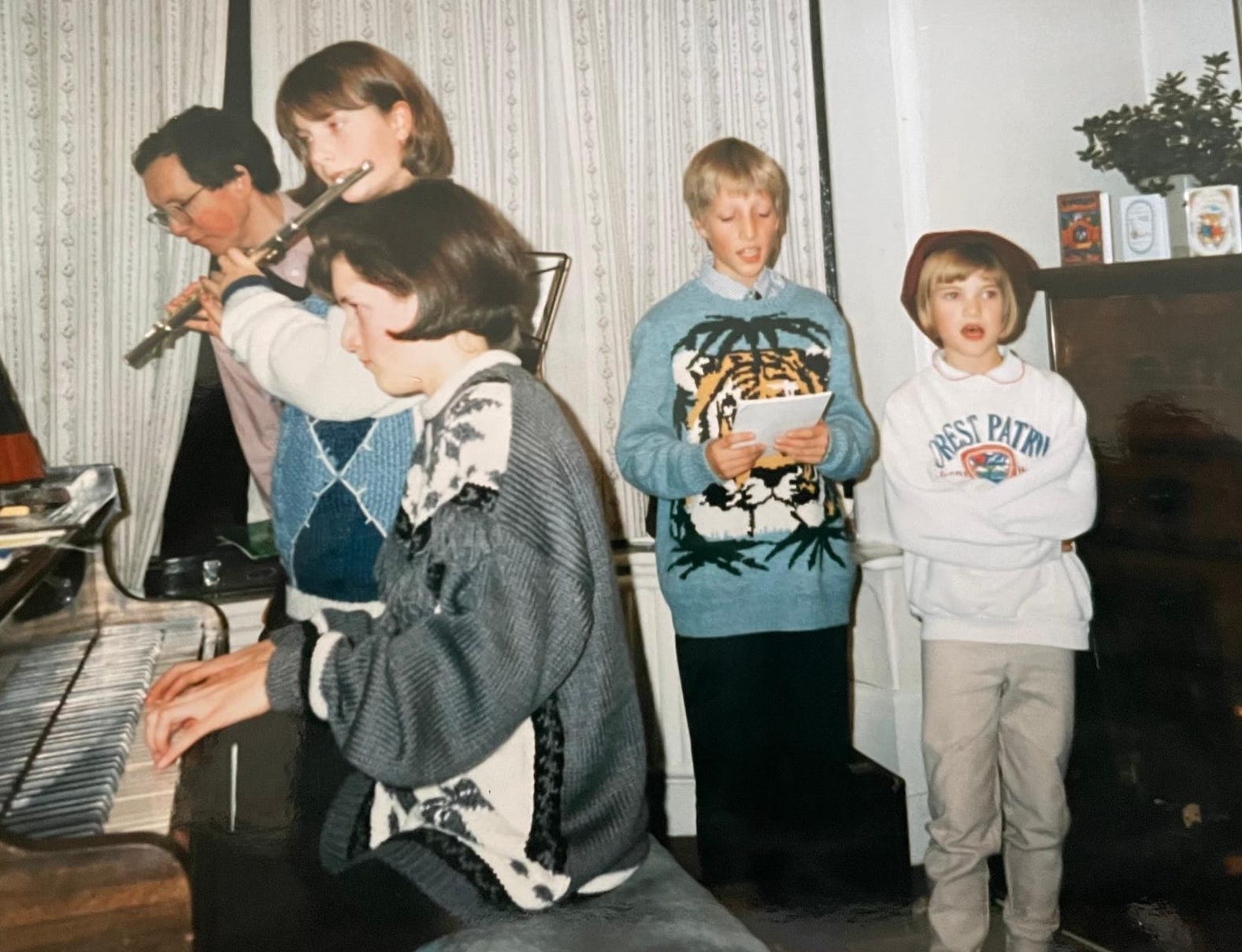
I began learning the piano at a relatively young age. I have memories of hot summer evenings sat on the piano bench in itchy school shorts, fidgeting as my elderly teacher1 instructed me to play a passage or set of scales again, again, AGAIN, until I got it right.
I probably bugged him with my fidgeting (I still fidget to this day, but now it mainly annoys my wife instead). But, looking back as an adult, I also had every right to be irritable. Because as I was trying to learn the very basics of scales, chords, melody and—in particular—rhythm, I had to contest with my teacher’s clock.
Imagine being asked to play in time, counting a silent 1 … 2 … 3 … 4 … in your head. You screw up your face and stick out your tongue in concentration because another repetitive rhythm is relentlessly trying to trip you up. The clock, the likes of which I haven’t seen since (because seriously, why would you own one) contained a series of glass tubes and metal marbles, like oversized ball bearings. Every minute or possibly thirty seconds, a marble would drop out of position, and roll, roll, ROLL its way down the glass tube, landing—clunk—among the other marbles. Presumably, some clever mechanism brought the marbles back up to the top, as the cycle continued endlessly. Every lesson, the clock ticked, the marbles dropped, the balls clunked.
If I do ever see one of these clocks again, I will likely go into an involuntary rage like Captain Hook, smashing the clock into tiny pieces.
For some reason I can’t quite fathom, I came to dread these lessons2. Eventually, I must have complained consistently enough as my parents allowed me to swap piano lessons for the significantly more infuriating instrument (for neighbours, family, and pets alike) — the trumpet. At this age, around eight or nine years old, I hated practicing. It seemed such a frustratingly futile waste of time, especially when I could have been outside playing football. At this early stage in the instrument, everything was new, everything was difficult. At least on the piano, beginners can make a half-decent sound. But on the trumpet… it takes years to get a really decent sound. And even when the sound finally becomes palatable, the practice includes plenty of strange sounds in the guise of ‘slurs’, ‘tonguing’, and ‘pedals’, which can sound a bit like a radiator having a mental breakdown3.
Confessional side note
To illustrate just how frustrating I found music practice - I once had such a fit of anger when practicing (and screwing up) my scales that I slammed the trumpet into the ground, bending the bell back like a crumpled flower. I can only apologise to my parents (hopefully I did at the time).
I used to hate music practice; until I didn’t.
There was a point when practice slowly turned from a chore into something I enjoyed, and then close to an obsession. The different facets of musicality started to come together, when I was suddenly able to play a scale or piece of music I had battled with for weeks. The satisfaction of progress became more and more apparent. I started in the school band, and found the joy of playing with others too.
Becoming ‘fluent’ in a musical instrument is like becoming conversational in a new language: very satisfying, but also practical. It unlocks conversations and friendships that were previously unavailable.
(If you saw this sledgehammer of a segue coming… well done!)
Reading is similar to learning an instrument. It can be infuriating at the start: slow, tedious, and the stories (or tunes) can be pretty basic. You want to get to the good stuff, but you aren’t ready for it yet4. So you plod, plod along, occasionally experiencing surges in technique or understanding. As you advance, and as you practice, reading becomes more fluent. Words take on greater meaning and sentences become more accessible. Rather than decoding each word intellectually, each word starts to contain feeling, shape, colour, emotion, that is accessed without thought. A single word begins to express a whole world of ideas.
Reading takes time to get to this stage. Years! And while it does become inherently enjoyable at some point, many children—far too many—do not reach this point. Like the millions of children who learn a musical instrument but hang it up before their level of skill catches up with their expectation for what they should sound like.
Readers and musicians alike need a lot of encouragement, especially early on. They need to understand that, yes, it can be enormously frustrating. It can be hard. It can be mentally tiring. It can be slow and tedious and require reading and re-reading over and again until it makes sense.
But all worthwhile things in this world come on the other side of graft. Satisfaction tastes sweetest when it is earned. You cannot shortcut your way to becoming a musician, CEO, reader, plumber, or mathematician. There may be more efficient routes to the summit, but everyone still has to work their way up somehow.
And those who quit never get to enjoy the view.
Thank you for reading. If you enjoyed this post, please consider sharing online or with friends, commenting, or clicking that lil’ heart button!
He was probably only forty, but he seems unfathomably ancient and wrinkled in my mind’s eye.
Psychoanalysts need not write in.
Later, when I was vaguely considering a career as a trumpeter, someone helpfully told me that it was basically blowing down a metal pipe for a living. That took the romance out of it a bit.
I reckon this is partly why children seem to learn quicker than adults - their expectations are lower. Give a child an instrument and they are delighted just to create a sound. Give an adult an instrument and they are upset if they don’t sound like Jacob Collier.
The throw back family photo tiger sweater is quite a standout
Excellent excellent article! And that clock was the bane of my existence.